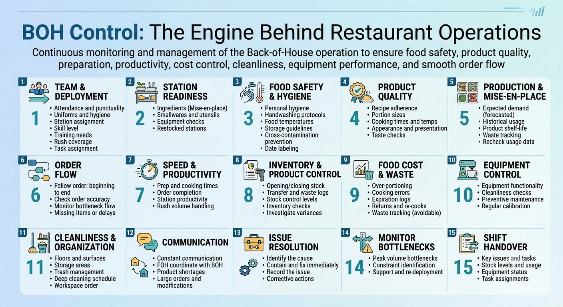
Back of house control the engine behind restaurant operations.
Operations Management
Back of House Control
Back of house control means continuously managing and monitoring the back of house operation to ensure food safety, product quality, preparation, productivity, cost control, cleanliness, equipment performance, and smooth order flow. The manager’s role is not to stand in the kitchen and tell people how to cook. It is to make sure the system is capable of producing the required result consistently.
1. Team and Deployment
Start with the people.
Monitor:
Attendance and punctuality
Uniform and hygiene
Station assignment
Skill level
Productivity
Rush coverage
Training needs
Communication between stations
Typical back of house stations:
Preparation
Frying
Grill
Saute
Assembly
Expedite
Packaging
Dishwashing
Key question: Do I have the right people in the right back of house stations for today’s workload?
2. Station Readiness
Before production or peak periods, verify:
Ingredients
Equipment
Mise en place
Smallwares
Utensils
Containers
Cleaning supplies
Restocked stations
A kitchen employee should never discover during the rush that we are out of something. Ready station equals smoother production, which equals faster service. Consistency is your best friend.
3. Food Safety and Hygiene
Monitor:
Personal hygiene
Handwashing
Food temperature
Storage temperature
Cross contamination prevention
Raw and cooked separation
Date labeling
First in first out and first expired first out where applicable
Cleaning and sanitizing
Chemical control
Pest control awareness
Food safety is not something you prepare for only when an inspection visits. It is a daily responsibility.
4. Product Quality
The back of house must produce according to specifications.
Monitor:
Recipe adherence
Portion size
Cooking time
Cooking temperature
Appearance
Taste
Texture
Presentation
Packaging
Standard plus portion check equals consistent quality. Conduct regular product checks.
5. Production and Mise en Place
Based on expected demand, consider:
Forecasted sales
Historical usage
Peak periods
Product shelf life
Preparation time
Current stock
Waste
Too little leads to shortages, delays, and lost sales. Too much leads to excess, deterioration, waste, and cost.
Objective: Right quantity, right item, right quality.
6. Order Flow
Follow the order from beginning to end:
Order entry, preparation and cooking, assembly, packaging and plating, expedite and handover.
Look for:
Piling
Duplicate work
Miscommunication
Bottlenecks
Missing items
Delays
Identify product and flow bottlenecks quickly.
7. Speed and Productivity
Monitor:
Order preparation time
Cooking time
Order completion time
Orders per hour
Station productivity
Idle time
Bottlenecks
Do not chase speed at the expense of quality, safety, or accuracy.
Objective: Fast pace, organized execution.
8. Inventory and Product Control
Monitor:
Opening stock
Usage
Transfers
Closing stock
Restocked products
Damaged products
Waste logs
Variances
Investigate unusual variances. For example, if expected usage is eight cases and actual usage is eleven cases, find the difference before looking for an explanation.
9. Food Cost and Waste
Monitor:
Over portioning
Cooking errors
Expiration
Spoilage
Incorrect preparation
Waste documentation
Returns
Recook food
Preparation waste
The objective is not zero waste, which is not realistic. Try to reduce avoidable waste while maintaining quality and portion.
10. Equipment Control
Monitor:
Cleanliness
Functionality
Temperature
Preventive maintenance
Regular calibration
Abnormal operation
Safety
When equipment fails, kitchen flow slows, orders are delayed, production capacity is reduced, staff is frustrated, and waste is created. One defective machine disrupts the full kitchen routine.
11. Cleanliness and Organization
A controlled back of house should be clean, organized, sanitized, regularly swept, free of unnecessary items, and easy to work in.
Monitor:
Floors
Walls
Work surfaces
Sinks
Shelving
Storage areas
Trash and receptacles
Daily cleanup plan
Weekly deep cleaning
A well kept workspace supports food safety, productivity, employee safety, and quality.
12. Communication
The back of house needs constant communication with the front of house, especially regarding:
Product shortages
Eighty six items
Preparation times
Large orders
Special modifications
Quality issues
Equipment problems
Expected peak volume
Example: Table four wait is running twenty five minutes. We are working on it now.
Otherwise, the customer waits, the front of house gets blamed, and the kitchen gets defensive.
13. Monitor Bottlenecks
During peak periods, ask: Where is the production constraint right now?
It could be:
Preparation
Frying
Grill
Bar
Packaging
Expediter
Equipment
Product availability
Action checklist: Support the bottleneck, do not let it drown the kitchen.
14. Issue Resolution
When something goes wrong:
Identify, contain, resolve, correct, verify.
Example: Rejected wrong orders. Do not just say be more careful next time. Ask:
Is the recipe clear?
Is additional training needed?
Is the station well organized?
Fix the system, not just the symptom.
15. Shift Handover
Ongoing back of house flow requires effective handovers:
Product shortages
Preparation needed for the next shift
Equipment issues
Stock count
Quality checks
Maintenance problems
Urgent tasks
Waste review
Pending tasks
A good handover prevents the next shift from starting behind.
Back of House Control Cycle
Plan, prepare, monitor, adjust, review, improve. This represents a continuous improvement cycle.
The Back of House Control Formula
People, plus food safety, plus product quality, plus station readiness, plus speed and productivity, plus equipment control, plus inventory and waste, plus cleanliness and organization, plus communication equals a controlled back of house operation.
Pre-Shift: Are Your Lines Actually Ready?
15 Signs of a Great Restaurant