Classic French vs. Real-World Line Reality: Flexing Culinary Words Won’t Save Your Station
Let’s talk about the absolute disconnect between what they teach you in a pristine culinary school classroom and what actually happens when you are standing in front of a screaming hot flat top during a Friday night rush.
I was brought up in raw gastronomy. I learned the trade by making food that people actually wanted to eat, dishes built around what the locals desired, what tasted incredible, and what filled a plate. But like a lot of guys looking to sharpen their edge, I went to school too. I memorized the classical French techniques. I learned how to turn a potato into a perfect 7 sided olivette, how to clarify a consomme until it looked like glass, and how to pronounce words that require you to roll your tongue like you’re starring in a theater production.
And do you want to know how much of that theoretical French textbook garbage ever truly came into play in the real world?
Barely any of it.
Because at the end of the day, your average customer sitting in a restaurant booth really doesn’t care about your classical pedigree. They want to eat. They want their food hot, they want it seasoned perfectly, and they want it executed with absolute consistency.
If you are lucky enough to be cooking in a Michelin-starred fine dining establishment where people are paying three hundred dollars a head to be experimental, then by all means, go ahead and flex your French words and your microscopic tweezer skills. That is the venue for it. That is where you show off your molecular geometry and talk about emulsion stability.
But you absolutely will not do that at the high-volume, local seafood and steakhouse on the Gulf of Mexico in Florida.
When you’re working a line like that, nobody gives a flying shit about “tourne” vegetables or whether your demi-glace was reduced for eighteen hours using calf bones imported from Europe. The tourists and locals coming off the water don’t want a plate with three drops of foam and a piece of protein the size of a postage stamp. They want a flawlessly seared ribeye, perfectly fried local seafood, and a line that moves like a well-oiled machine so their food hits the table before they finish their first beer.
If you walk onto a high volume line thinking you’re going to revolutionize the menu with your fancy culinary school jargon, the veteran line cooks will laugh you right out of the building. The line doesn’t care about your ego; it cares about output. The true art of gastronomy isn’t hiding behind French terminology it’s understanding your demographic, respecting the product the locals want, and mastering the raw execution required to feed hundreds of people a night without your station breaking down into total anarchy.
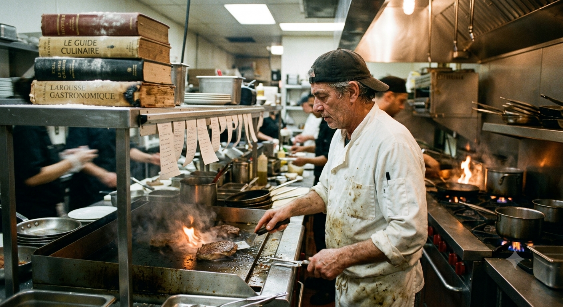
Stop trying to flex your textbook knowledge on a line that requires pure unadulterated horsepower. Learn the techniques, lock them away in your tool belt, but adapt your execution to the room you are standing in. Feed the people what they want, keep your station tight, and leave the French accent at the back door.
What was the biggest reality check you got when you transitioned from culinary school or fine dining concepts into a high volume, high horsepower kitchen?