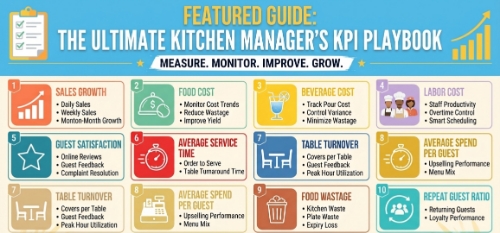
10 Key Restaurant KPIs Every Kitchen Manager Should Master
Running a successful restaurant isn’t just about crafting delicious food; it’s about making data-driven decisions to ensure profitability and guest satisfaction. This guide focuses on 10 essential Key Performance Indicators (KPIs) that every kitchen manager must measure, monitor, and improve to achieve consistent growth.
Core Tenet for Success
“What gets measured gets improved.” Successful kitchen managers don’t just manage the food they manage the numbers. The path to a thriving kitchen is paved with careful tracking and continuous improvement. This is your framework.
Phase 1: Revenue and Cost Management
These metrics directly impact your bottom line. They are your financial pulse.
1. Sales Growth
While often seen as a front-of-house metric, Sales Growth provides the fuel for everything the kitchen does. It indicates that your menus, marketing, and reputation are attracting customers.
Actionable Advice:
Compare daily and weekly sales data to previous periods.
Monitor Month-on-Month Growth to understand long-term trends and adjust your inventory and staffing accordingly.
2. Food Cost
Food is your biggest ongoing expense. Efficiently managing it is crucial. This KPI measures the ratio of your food-related costs to your food revenue.
Actionable Advice:
Monitor cost trends on a weekly basis to catch price spikes early.
Train staff to reduce wastage at every step.
Optimize portion control and menu items to improve the total food yield from all inventory.
3. Beverage Cost
Often overlooked by dedicated kitchen managers, understanding beverage costs (especially with extensive coffee or drink programs) is vital.
Actionable Advice:
Calculate and track the exact “pour cost” of your beverages (cost of product/menu price).
Focus on controlling variancethe gap between your ideal pour cost and your actual pour cost.
Minimize beverage wastage through proper storage, measurement, and barista/bartender training.
4. Labor Cost
A high labor cost can cripple a kitchen’s profitability, while a too-low cost impacts service and food quality. This KPI helps you optimize your biggest human investment.
Actionable Advice:
Track staff productivity (total sales / total labor hours) to understand efficiency.
Implement smart scheduling software based on historical sales data (not gut feeling).
Strictly control overtime hours to prevent burnout and overspending.
Phase 2: Operational Efficiency
These metrics measure how well your kitchen is actually running and producing its final product.
6. Average Service Time
Speed of service directly relates to turning tables and maximizing capacity. It measures how long a guest waits for their order.
Actionable Advice:
Measure the ‘Order to Serve’ time for different stations.
Identify bottlenecks and optimize the line flow to keep wait times to a minimum.
9. Food Wastage
Food waste is pure profit being thrown in the trash. It’s also an environmental concern and an operational red flag.
Actionable Advice:
Require staff to log all types of waste: Kitchen Waste (trimming), Plate Waste (uneaten food left by guests), and Expiry Loss (inventory expiring on the shelf).
Analyze the logs weekly to adjust purchasing habits and menu items.
Phase 3: The Guest Experience
These KPIs measure the resulting impact on your customer, who will dictate your long-term success.
5. Guest Satisfaction
This is your leading indicator for future sales and repeat business. It measures the guest’s qualitative experience.
Actionable Advice:
Aggressively monitor online reviews (Google, Yelp, TripAdvisor).
Develop a system to proactively collect and analyze direct guest feedback in the restaurant.
Establish a rapid, standard procedure for complaint resolution, ensuring negative feedback is addressed professionally and immediately.
7. Table Turnover
This KPI measures how efficiently you use your physical space and maximum seating capacity. A faster turnover (within a respectful dining window) increases your potential volume.
Actionable Advice:
Calculate the average covers per table during specific time slots.
Analyze peak hour utilization rates to maximize profitability when demand is highest.
8. Average Spend Per Guest
This measures how effective your FOH/BOH teams are at guiding guests toward higher-value menu choices (without lowering table turn).
Actionable Advice:
Analyze the menu mix (the combination of profitable and popular items) and adjust pricing or menu design accordingly.
Implement consistent upselling training and measure performance based on guest spend.
10. Repeat Guest Ratio
This measures your loyalty rate. Attracting a new guest costs much more than retaining an existing one. This KPI shows if your food and service are compelling.
Actionable Advice:
Measure the total percentage of returning guests on a quarterly basis.
Evaluate the performance of any in-house loyalty programs in increasing visit frequency.
Summary of Success
The path to a highly successful kitchen operation involves transitioning from operating on feeling to managing on metrics.
Line architecture and labor infrastructure