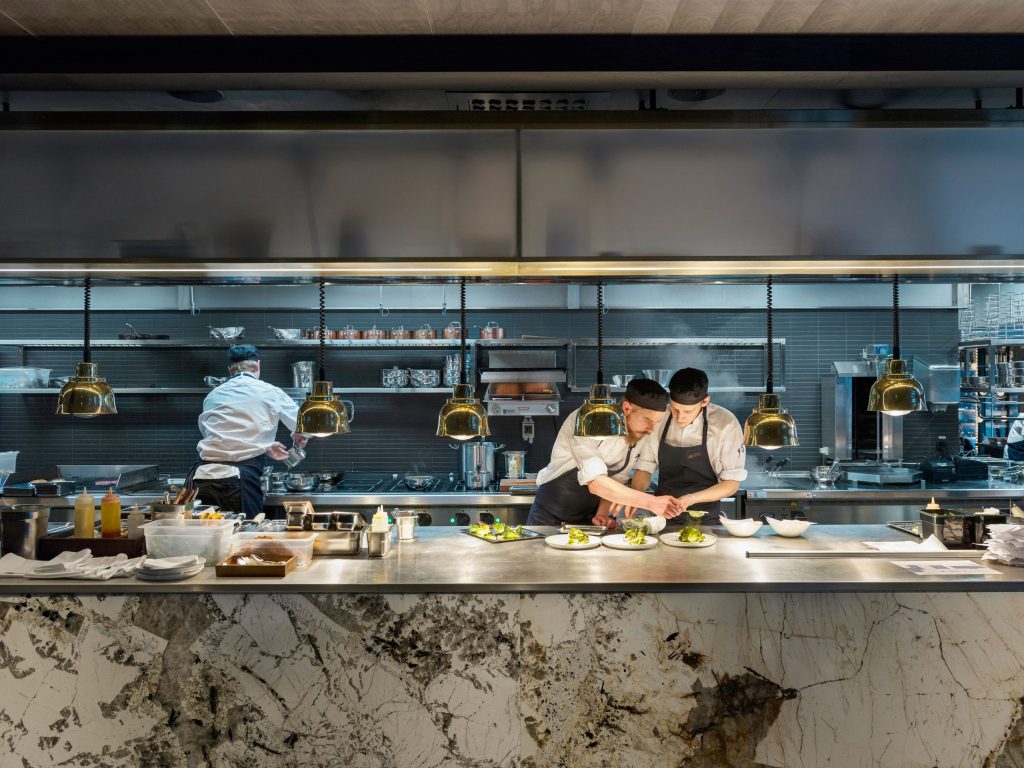
THE OPERATIONAL TURNAROUND MANUAL: BACK OF THE HOUSE COMPONENT
SECTION: LINE ARCHITECTURE AND LABOR INFRASTRUCTURE
I. THE GEOMETRY OF THE ZERO-STEP STATION
Labor optimization is not a disciplinary problem; it is a spatial engineering problem. Forcing a kitchen crew to run faster or work harder to compensate for a poorly mapped line is a management failure that guarantees high turnover, systemic ticket delays, and bleeding labor margins. True optimization is achieved by eliminating physical distance and structural friction. Every time a line cook is forced to turn 180 degrees, take two steps to reach a low-boy drawer for a protein, or leave their immediate tile grid to hunt for a clean squeeze bottle, the house loses fifteen to thirty seconds. Over a hundred-cover dinner rush, these minor fragments of wasted movement compound exponentially into catastrophic ticket bottlenecks and inflated, non-productive labor hours.
An optimized line station must be engineered so that the operator can execute ninety-five percent of their assigned menu items without moving their feet from their primary floor tile.
1. The Spatial Horizon Audit: Station setup during the prep window must be governed by strict ergonomic mapping. Stand directly at the center of the station. Draw an imaginary semi-circle with your arms extended. Every raw protein, finishing garnish, utensil, squeeze bottle, and pan backup required to survive the peak velocity of the shift must sit within this physical radius. High-use items must occupy the primary tier at waist level. Secondary backups must be layered vertically in overhead racks or laid out horizontally from left to right in the exact chronological order of dish assembly.
2. The Lockdown Protocol: A line cook should never leave their designated station mid-rush to retrieve an item from the walk-in cooler or dry storage. The moment a cook steps away from the line during active service, the velocity of the entire kitchen breaks, and adjacent stations are forced to over-extend to cover the gap. All secondary product backups, pre-portion bags, and clean line utensils must be staged in assigned under-counter low-boys or refrigeration wells prior to the front doors opening. If an item runs out, it indicates a failure of the pre-shift line par audit, not an emergency to be solved by abandoning the station.
II. CHRONOLOGICAL CROSS-TRAINING AND TEAM VELOCITY
The traditional, segmented kitchen model where a cook only understands or operates a single station is an immense financial and operational liability. If your grill station is completely buried under an unexpected surge of steak orders while your fry cook is standing motionless watching the screens, your labor dollar allocation is fundamentally broken. Turning a kitchen around requires transitioning the staff away from isolated station mentalities and shifting them into an integrated line unit based on chronological cross-training.
1. Adjacent Station Mastery: Cross-training cannot be haphazard; it must happen symmetrically along the physical line. The prep cook must fully master the pantry and salad setup. The pantry operator must be thoroughly trained on the fry station. The fry cook must be fully capable of stepping up to the wheel or the grill. By linking training to physical adjacency, cooks can seamlessly assist the station directly to their left or right without crossing paths or disrupting the physical flow of the kitchen.
2. The Float Trigger Threshold: Eliminate the need for managers or expeditors to scream for help by establishing automated, data-driven thresholds for line intervention. If the pantry station hits more than four active tickets hanging on the rail, the adjacent fry cook automatically redirects ten percent of their physical focus to plating cold appetizers and salads, without waiting for an instruction. You pay for total kitchen throughput and ticket completion times, not isolated station performance. The line must function as a fluid, self-balancing engine where labor naturally flows to the point of highest resistance.
III. THE PREP-TO-LINE CONVERGENCE MATRIX
Kitchen labor capital is routinely squandered during the morning prep hours due to a complete lack of a structured operational roadmap. If your prep crew arrives at the back door at 8:00 AM and spends the first twenty to thirty minutes drinking coffee, moving slowly, and casually deciding what ingredients to cut, you are actively burning your profit margins before a single guest walks through the door.
1. The Par-Sheet Mandate: The morning prep shift does not begin at the cutting board or the sink; it begins at the data desk. The morning prep par-sheet must be an absolute directive, dictated by hard numbers derived from historical sales metrics, catering counts, and POS data from the previous week. The document must state the exact weights, exact slice counts, and exact container volumes required for the day. No guessing, no intuition, and no over-prepping. Over-prepping does not create a safety net; it destroys product freshness, degrades food quality, and hides massive food cost waste.
2. Value-Stream Batch Processing: To optimize labor hours, similar raw ingredients must be processed globally across all menus simultaneously rather than station by station. If the pantry station, the grill station, and the bulk recipe book all require diced green cabbage or minced garlic for the day’s service, a single cook must be assigned to process the entire cumulative volume for the house in one highly efficient, bulk batch execution. This eliminates the massive time waste of multiple cooks individually setting up, sanitizing, using, and breaking down separate cutting stations throughout the morning hours.
I firmly believe that kitchen survival hinges on more than just your role or position It is understanding the entire framework and makeup of the restaurant. This puts you ahead of the average Joe trust and believe. Your value goes up the more you know.
Restaurant Economics: The Operational Turnaround Manual
The weekend kitchen audit: a practical guide to restaurant economics
The Hidden Enemy (and ally): Mastering carryover cooking on a brutal line
1 thought on “Line architecture and labor infrastructure”