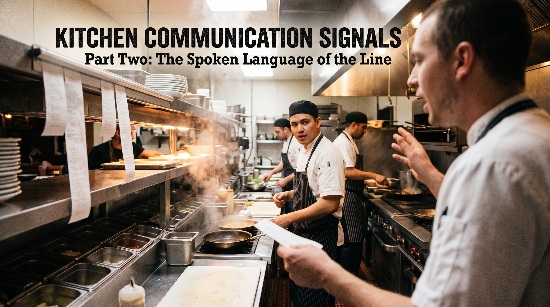
In Part One, we covered what you can say without making a sound. But when the room is loud, the board is full, and the printer won’t stop, silent signals aren’t enough. You need words. Short, standard words that everyone on the line hears the same way, every night, from the newest dishwasher to the sous chef.
A kitchen is a high-pressure team environment, and teams under pressure fail in predictable ways: the message wasn’t clear, the message wasn’t heard, or nobody confirmed it was heard. Fields like aviation and healthcare solved this problem decades ago with structured, repeatable communication. The kitchen can borrow the same ideas.
🔁 The Rule Behind Every Call: Call It, Echo It
Every call gets an answer. If you call it and nobody echoes it, you haven’t communicated. You’ve just made noise.
- Expo: “Fire table 12, two ribeyes medium, one salmon.”
- Line: “Heard, two ribeyes medium, one salmon.”
This is the kitchen version of what safety-critical industries call closed-loop communication: the sender gives the message, the receiver repeats it back, and the sender confirms it. The echo proves the cook caught the order, the temperature, and the count. Most remakes start with a call nobody repeated.
⚠️ Core Calls Every Cook and Server Should Know
Movement and Safety
- “Behind”: I’m passing behind you. Don’t step back or turn.
- “Corner”: I’m coming around a blind spot.
- “Hot” / “Hot behind”: I’m carrying something that will burn you.
- “Sharp”: I’m carrying a knife. Make room.
- “Door”: Someone is coming through the walk-in or a swinging door.
Pacing and Tickets
- “Fire”: Start cooking now.
- “Hold”: Don’t start this yet.
- “Pick up”: Plate is ready, send it out.
- “On the fly”: Needed immediately, jump the queue. Use it sparingly, or it stops meaning anything.
- “Walking”: I’m leaving the station with the product you need.
Guest-Specific
- “Allergy”: Stop. Clean board, clean pans, clean hands, and a second set of eyes on the plate. This call is never casual.
- “VIP” / “Special”: A table is getting extra attention. Extra care on the plate.
- “Rush” / “Mistake on the table”: A recovery plate, top priority.
📝 Written Signals Matter Too
Voices get lost in the noise. Paper doesn’t. Back up your verbal calls with a written system the whole team understands.
- Ticket flags: Circle the allergy. Underline the modifier. Star the VIP.
- Pass markers: Use a consistent system, like a clip or card for table status, so nobody guesses.
- The 86 board: One spot, updated by one person, and seen by every server before service. A sold-out item that lives only in someone’s head will end up on a ticket.
🚧 Common Breakdowns
- Silent assumptions. “I thought you heard me.” If it matters, say it, and make sure it comes back.
- Overusing urgency. If everything is “on the fly,” nothing is.
- Calling over the noise. Don’t yell louder. Walk to the person, or use the expo.
- Mixed vocabulary. If one shift says “hands” and another says “pick up,” your new hires will fail. Pick one word per meaning and keep it.
- Tone problems. A call is information, not an attack. “Behind!” shouted in anger gets the same response as “behind” said clearly, except the first one costs you morale.
🎯 Why Clear Communication Pays Off
Good communication isn’t soft. It shows up in numbers: fewer remakes means lower food cost, faster ticket times mean more table turns, and fewer collisions and burns means fewer injuries. It also shows up in culture. Cooks who know exactly what’s expected of them, and who get a clear answer when they call something out, are calmer, stay longer, and train the next person the same way. Clarity is cheap. Turnover and waste are not.
📋 Build Your Own Line-Up Script
Pick 8 to 10 calls. Write them down. Go over them at pre-shift for a week. Test new hires on them during their first three shifts. Post the list at the pass. Review it every few months and cut anything the team doesn’t actually use. A shared vocabulary does more for a kitchen than any piece of equipment you can buy.
Takeaway: Hand signals keep the room calm. Verbal calls keep the line accurate. The best kitchens run both, and they run them the same way every night.
📚 References and Further Reading
Kitchen Terminology and Calls
- WebstaurantStore: Kitchen Slang Phrases
- Escoffier School of Culinary Arts: Chef Jargon
- MICHELIN Guide: Restaurant Lingo
- US Language Services: Slang in the Kitchen
Team Communication and FOH/BOH Coordination
- Chefs Resources: Communication Systems in High-Pressure Kitchens
- Clover: Unifying the Front and Back of House
- Heart of the House: Bridging the FOH/BOH Divide
Closed-Loop Communication and Teamwork
Allergen Safety
Kitchen Communication Signals: Silent Signals Between Front of House and Back of HouseFree Restaurant Calculators