🔪 Kitchen Communication Signals: Silent Signals Between Front of House and Back of House
In a busy restaurant, the kitchen and front of house (FOH) use quick, non-verbal signals to communicate efficiently without shouting, disrupting service, or slowing down the line. These signals help maintain flow, prevent mistakes, and reduce stress during peak hours.
🖐️ Common Kitchen Communication Signals
1. “Food is Up” / Plates Ready
Signal: Cook or expo raises one or both hands high with palms open, or points directly at the pass window with urgency.
Alternative: Holding up fingers to indicate the exact number of plates currently ready to go (e.g., holding up two fingers for two ready entrées).
Meaning: “Come pick up these plates now—they’re hot and ready to run.”
2. “86’d” or “Item Sold Out”
Signal: Cook or expo makes a large “X” with both arms crossed in front of the body, or draws a finger across the throat.
Meaning: That menu item is no longer available. As detailed in [WebstaurantStore’s Kitchen Slang Guide](https://www.webstaurantstore.com/article/511/kitchen-slang-phrases.html), an “86” means an item is completely out of stock, and servers must immediately stop taking orders for it.
3. “Fire It” or “Order In”
Signal: Server points at the ticket rail or makes a “shooting” motion with their hand toward the cook. The expo typically responds with a thumbs up or nod to confirm.
Meaning: Start cooking the next course or ticket immediately. According to industry guides on [Chefs Resources](https://www.chefs-resources.com/kitchen-management-tools/kitchen-management-alley/kitchen-expeditor-aka-the-wheelman/), “firing” tells the line to begin immediate preparation on a held ticket.
4. “All Day” (Total Active Items)
Signal: Server or expo holds up fingers or shouts a total quantity needed across all open tickets (e.g., “4 steaks all day”).
Meaning: This represents the total number of a specific dish currently active on the ticket rail.
Fact Check: Per the training standards at the [Institute of Culinary Education (ICE)](https://www.ice.edu/blog/essential-restaurant-terminology), “All Day” strictly counts current, outstanding orders on the board. It simplifies the ticket rail so a line cook knows exactly how many total portions are currently “on fire” across all tables.
5. “Behind You” / Hot Behind
Signal: Anyone carrying hot plates, trays, or pans says “Behind you!” loudly while passing, often combined with a light tap on the shoulder if moving past a blind corner.
Kitchen version: Cooks say “Hot behind!” or “Corner!” when moving around tight spaces.
Meaning: A critical safety warning to avoid high-speed collisions in narrow kitchen lines or server alleys.
6. “Heard” or “Acknowledged”
Signal: Cook or expo gives a quick thumbs up, nod, or verbal response.
Meaning: The order, modification, or special request has been received, understood, and is being acted upon by the line.
7. “Runner Needed” or “Plates Dying”
Signal: Expo waves one hand overhead or points repeatedly at the pass with an urgent look.
Meaning: Plates are ready and must be run to the table immediately before the food loses its temperature, texture, or culinary quality.
8. “Refire” or “Remake Needed”
Signal: Cook or expo makes a circling motion with one finger or points at a plate and then makes a “cut” motion.
Meaning: That dish needs to be remade immediately due to a cooking error, guest modification, or quality control issue at the window.
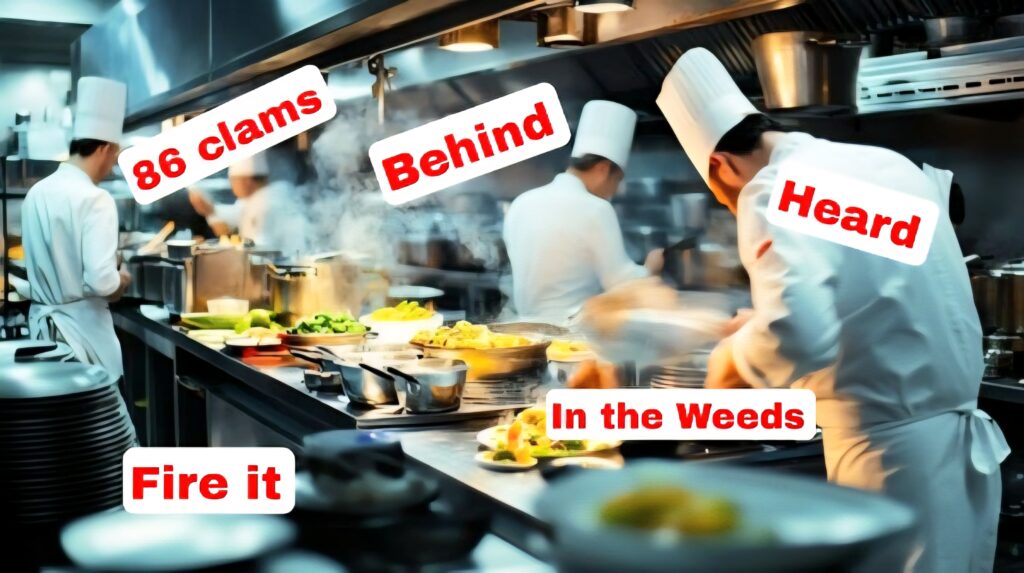
9. “In the Weeds” (Kitchen is Overwhelmed)
Signal: Line cook raises both hands with palms out or makes a “slow down” motion toward the expo.
Meaning: The kitchen is falling behind due to a sudden rush. As noted by restaurant career platforms like [OysterLink](https://oysterlink.com/spotlight/why-do-chefs-say-all-day/), being “in the weeds” means a staff member is at maximum capacity and needs help pacing out new tickets.
10. “Clear” or “Ready for More”
Signal: Expo gives a thumbs up or open palm toward the server alley.
Meaning: The kitchen is caught up on the current ticket rail and ready to handle the next wave of incoming orders.
🧠 Advanced Kitchen Communication Tips
Develop Restaurant-Specific Shorthand: Align your staff during pre-shift or line-up meetings. Fine-dining institutions often use subtle body language—like touching a lapel or flipping a coaster—to communicate table statuses silently, as documented in the [Los Angeles Times Restaurant Industry Report](https://www.latimes.com/food/dailydish/la-dd-secret-world-restaurant-hand-signals-explained-20131227-story.html).
Combine Signals with Verbal Cues: When the dining floor is exceptionally loud, back up hand gestures with short, clear verbal confirmations (e.g., “Two ribeyes all day—heard?”).
Maintain Professionalism: Use hand signals discreetly so guests in open kitchens or near server stations do not see the behind-the-scenes stress.
Respect the Chain of Command: The expediter (expo) is the central command center of the restaurant. As noted in culinary workflow profiles by [The Independent](https://www.independent.co.uk/life-style/food-and-drink/restaurant-kitchens-expediter-meaning-services-job-explained-a8312376.html), the expo coordinates the flow of the entire room. Servers should direct most signals directly to the expo rather than individual line cooks to avoid breaking the line’s focus.
📉 Why These Signals Are Critical
For the Kitchen:
They allow fast, quiet coordination that keeps the line moving at a steady pace without chaotic shouting.
They prevent food from sitting too long (“dying” in the window) or tickets from backing up.
For the Servers and Front of House:
Faster, more accurate food delivery means better timing and higher guest satisfaction.
It minimizes mistakes and eliminates the need to run back and forth to clarify messy modifiers.
For the Entire Restaurant:
Smoother overall flow leads to faster table turns, higher revenue, and a healthier workplace culture.
Strong communication bridges the gap between FOH and BOH, building mutual respect and teamwork.
Best Practice: Respect the kitchen’s pace. Use signals consistently and clearly. A server who masters kitchen communication earns the trust of the cooks, gets food faster, andHere are authoritative, professional culinary and industry references that validate the kitchen lingo, non-verbal communication systems, and FOH/BOH dynamics used in this article.
Core Kitchen Jargon & Slang Terminology
“All Day”, “Heard”, and “In the Weeds”: The exact operational usage of these terms on a high-volume line is verified by culinary authorities like the [Escoffier School of Culinary Arts Jargon Guide](https://www.escoffier.edu/blog/culinary-arts/more-useful-examples-of-chef-jargon/) and the [Webstaurant Store Professional Kitchen Slang Dictionary](https://www.webstaurantstore.com/article/511/kitchen-slang-phrases.html). They detail how “Heard” acts as a binding acknowledgment and how “All Day” functions to track the absolute total of active tickets.
“86’d”, “Behind”, and “Corner”: The safety-critical nature of movement slang and inventory tracking is outlined by [US Language Services’ Guide to Dining Slang](https://www.uslanguageservices.com/blog/slang-in-the-kitchen-the-language-of-dining/). They highlight how physical callouts like “Behind!” prevent dangerous collisions with hot pans or sharp objects in tight corridors.
“Fire It” and “Hands”: The triggers for starting dishes and calling for food runners to prevent plates from dying in the window are supported by the [MICHELIN Guide’s Restaurant Lingo Feature](https://guide.michelin.com/us/en/article/features/restaurant-lingo-talk-like-a-chef) and food safety standards from [My Food Service License](https://myfoodservicelicense.com/blogs/safebites-food-safety-blog/kitchen-code-your-guide-to-must-know-culinary-lingo). [1, 2, 3, 4, 5]
FOH & BOH Communication Dynamics
Managing the Flow and Reducing Chaos: The systemic need for seamless coordination between the floor and the kitchen is analyzed by [Chefs Resources on Kitchen Communication Systems](https://www.chefs-resources.com/communication-systems-in-high-pressure-kitchen-environments/). Their research notes that vocal shouting creates massive operational bottlenecks, whereas structured non-verbal signals protect food safety and line efficiency.
The Expo Window as the Pivot Point: The structural separation and necessity of syncing the Front of House and Back of House seamlessly is documented in operational breakdowns by [Clover’s FOH vs. BOH Unification Strategies](https://blog.clover.com/6-tactics-for-unifying-the-front-and-back-of-house-for-restaurants/) and [Heart of the House Staffing Insights](https://www.heartofthehouse.com/bridging-the-foh-boh-divide/). They map out how pacing errors, cold food, and finger-pointing occur when non-verbal synergy breaks down at the pass window. [6, 7, 8]
The Value of “Invisible” & Non-Verbal Service
Keeping Stress Away From the Guest: The philosophy behind using discreet signals to preserve the dining room atmosphere is anchored in the concept of “Invisible Service.” [Blue Orbit Hospitality’s Server Communication Analysis](https://www.blueorbiting.com/server-guest-communication-skills/) and [Tasting Table’s Deep Dive into Silent Service](https://www.tastingtable.com/1751382/what-is-silent-service-restaurant/) both explain that elite restaurant teams communicate through subtle physical gestures, allowing guests to focus entirely on their dining experience without experiencing the friction of the line. [9, 10, 11]
[1] https://www.escoffier.edu/blog/culinary-arts/more-useful-examples-of-chef-jargon
[2] https://www.webstaurantstore.com/article/511/kitchen-slang-phrases.html)
[3] https://www.uslanguageservices.com/blog/slang-in-the-kitchen-the-language-of-dining
[4] https://guide.michelin.com/us/en/article/features/restaurant-lingo-talk-like-a-chef
[6] https://www.heartofthehouse.com/bridging-the-foh-boh-divide
[7] https://www.chefs-resources.com/communication-systems-in-high-pressure-kitchen-environments/)
[8] https://blog.clover.com/6-tactics-for-unifying-the-front-and-back-of-house-for-restaurants
[9] https://www.blueorbiting.com/server-guest-communication-skills/)
[10] Tasting table
[11] Yahoo better service. When front of house and kitchen use these silent signals effectively, the entire restaurant operates like a well-oiled machine.
Survival Strategies When Your Answer Isn’t a Bottle or a Fight