

7 Silent Profit Killers Crushing Your Restaurant Profits (And How to Fix Them)
7 Silent Profit Killers Crushing Your Restaurant Profits (And How to Fix Them)
Running a successful restaurant is one of the toughest businesses in the world. With average profit margins hovering between 3% and 5%, every dollar counts. Yet many owners unknowingly allow silent profit killers to drain revenue month after month. These aren’t flashy disasters like a kitchen fire — they’re quiet, everyday operational mistakes that compound over time.
The infographic below, “7 Silent Profit Killers,” breaks down the most common pitfalls restaurant owners face and provides clear, actionable solutions. Whether you run a fine-dining spot, a casual bistro, or a fast-casual concept, these issues affect every type of operation. By identifying and fixing them, you can protect your bottom line and dramatically improve profitability
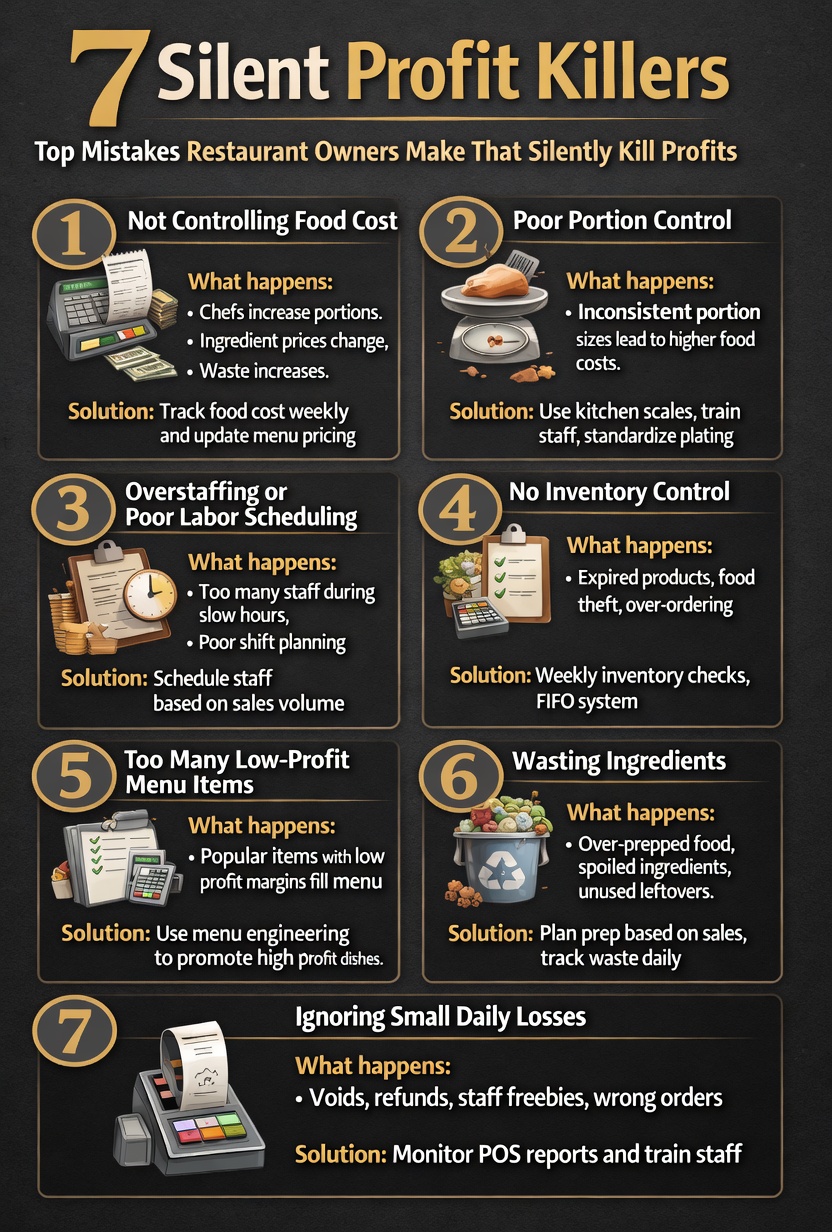
1. Not Controlling Food Cost
Food cost is typically your largest controllable expense. When chefs increase portions to please customers, ingredient prices change without notice, or waste accumulates, your food cost percentage climbs quickly — often exceeding the ideal 28-35% range.
What happens: Higher costs directly reduce gross profit on every plate sold.
Solution: Track food costs weekly using your POS system and standardized recipes. Compare actual costs against theoretical costs and adjust menu prices immediately. Simple spreadsheet tracking or restaurant management software makes this effortless and prevents small leaks from becoming major losses.
2. Poor Portion Control
Inconsistent portion sizes are a silent budget killer. One server scoops extra fries, another plates generous proteins, and suddenly your food costs spiral.
What happens: Customers receive uneven experiences and your ingredient usage exceeds recipe standards, inflating costs.
Solution: Equip your kitchen with digital scales, create visual plating guides, and train every staff member on exact portions. Standardizing plating not only controls costs but also ensures consistent quality that keeps guests coming back.
3. Overstaffing or Poor Labor Scheduling
Labor is often the second-largest expense after food. Scheduling too many staff during slow periods or failing to align shifts with peak sales times wastes money fast.
What happens: Payroll eats into slim margins even on slow weekdays.
Solution: Use historical sales data to build schedules based on actual volume. Modern scheduling apps can forecast busy hours and help you right-size your team. Reviewing labor cost as a percentage of sales weekly keeps this expense under control.
4. No Inventory Control
Without regular inventory checks, restaurants lose money through expired products, unnoticed theft, and over-ordering that leads to spoilage.
What happens: Valuable stock sits unused or disappears, driving up costs and creating cash-flow problems.
Solution: Perform weekly inventory counts and adopt a First-In, First-Out (FIFO) rotation system. Digital inventory tools linked to your POS can automate reordering and flag low-stock or expiring items before they become waste.
5. Too Many Low-Profit Menu Items
Popular dishes that look profitable on paper often have razor-thin margins once portioning and waste are factored in.
What happens: These items crowd your menu and dilute overall profitability.
Solution: Conduct menu engineering: calculate contribution margin for every item and highlight high-profit “stars.” Move low-margin items to less prominent positions or remove them entirely. Promote profitable dishes with suggestive selling and specials to shift customer choices naturally.
6. Wasting Ingredients
Over-prepping, spoilage, and unused leftovers quietly destroy profits every single day.
What happens: Fresh produce wilts, prepped items go unused, and expensive ingredients end up in the trash.
Solution: Base prep quantities strictly on forecasted sales. Track daily waste with a simple log and review it in team meetings. Small changes like proper storage techniques and portioned prep containers can cut ingredient waste by 20-30% almost immediately.
7. Ignoring Small Daily Losses
Voids, refunds, staff freebies, comped meals, and wrong orders may seem minor individually, but they add up fast.
What happens: These “nickel-and-dime” losses can total thousands over a month.
Solution: Monitor POS reports daily and train staff on accurate ordering and upselling. Create clear policies around comps and freebies. Regular reviews turn small habits into major savings.
Take Action Today
The good news? Every one of these silent profit killers has a straightforward fix. Start by downloading or printing the infographic above and conducting a quick audit of your own operation this week. Focus on just one or two areas first, most owners see immediate results within 30 days.
Implementing strong food cost control, portion standards, inventory systems, and daily monitoring can easily add 2-5 percentage points to your bottom line. In a business where margins are already tight, that difference often means the difference between struggling and thriving.
Ready to protect your restaurant’s profits? Share this post with your management team, schedule a full operations review, and watch those silent killers disappear. Your future self, and your bank account, will thank you.