
Crystal River ~ FLA
The Grill Map
The Grill Map (often called a Broiler Map) is a foundational technique in high-volume professional kitchens. It is a mental or physical grid system used to organize the surface of the grill to ensure every protein is cooked to the exact requested temperature without the cook losing track during a heavy rush.
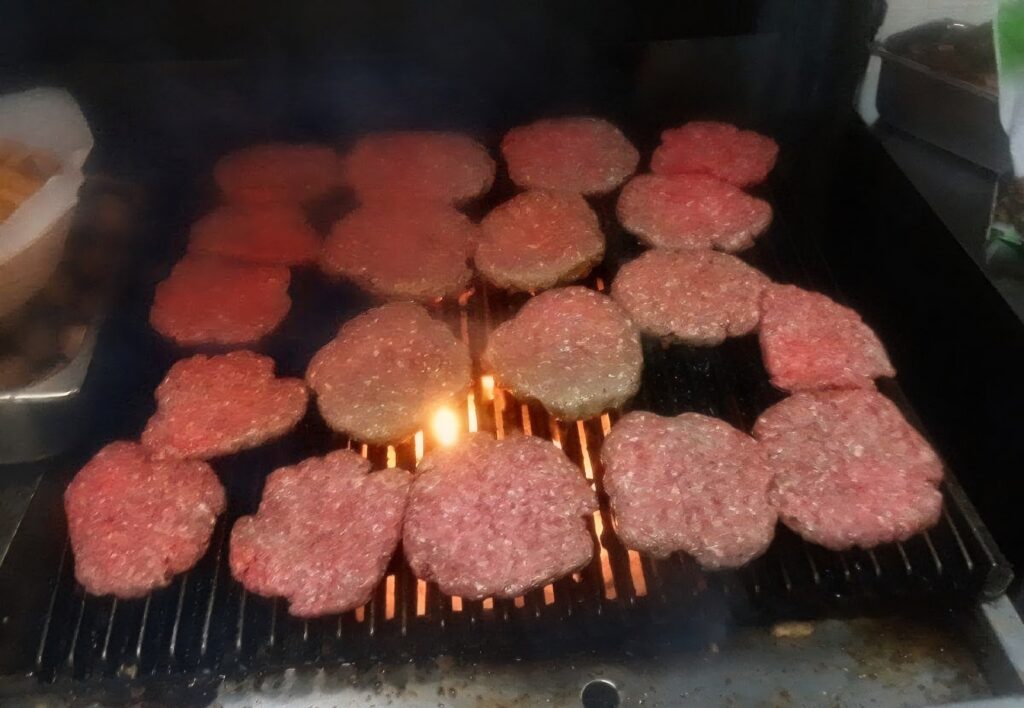
You’ll want to know this one, fire 19 burgers three are going kids…
Here is the theory and practical application of the Grill Map:
The Theory of the Grill Map
The core philosophy is spatial organization equals precision. Instead of relying on memory for each individual steak or chop, the line cook uses the geography of the grill as a visual data board. By assigning specific zones to specific temperatures, the cook can look at the grill and instantly know the status of every item based solely on its coordinates.
1. The Coordinate System
The grill is typically divided into a grid, often visualized as 4 to 6 vertical lanes. In most systems, the horizontal axis (left to right) represents the degree of doneness:
– Far left: Rare / Blue
– Mid-left: Medium Rare
– Center: Medium
– Mid-right: Medium Well
– Far right: Well Done / Butterfly
2. The Vertical Timeline (The Queue)
The vertical axis (front to back) represents time and priority:
– The back (hot zone): New drops. This is where you sear the meat and establish your marks.
– The middle (steady zone): Active cooking. Items move down to the middle once they have been turned to reach their target internal temperature.
– The front (cool zone/resting): Finished items or items that need to dwell to reach a temperature without burning the exterior.
3. The Rotation and Marking
The map relies on a consistent physical rotation to track progress:
1. The 10 o’clock drop: Protein is placed at an angle to create the first set of char marks.
2. The 2 o’clock turn: Protein is rotated 90 degrees to create the crosshatch diamond marks.
3. The flip: The protein stays in its assigned map lane but is flipped over to finish.
Why This Works for the Team
– Silent communication: If a lead or sous-chef walks up to the station, they don’t have to ask, “Which one is the Medium Well?” They can see it sitting in the fourth lane and know exactly where it stands.
– Reduced decision fatigue: During a push, a cook shouldn’t be thinking about “how long” a steak has been on; they should be looking at where it sits on the map.
– Consistency: It eliminates the touch-and-guess method, ensuring that a Rare steak never accidentally ends up on a Medium Well plate because it was moved to the wrong spot.
The Golden Rule of the Grill Map: “If you move it, you lose it.” Once a protein is assigned a lane based on the ticket, it must stay in that lane’s vertical track until it hits the resting board.
Practical Line-Cook Tactics
Clean grates frequently — residue and buildup create hot/cold spots that ruin consistency.
Oil the grates lightly before drops to prevent sticking and help with even heat transfer.
Rotate proteins within their lane but never move them to a different temperature lane (Golden Rule).
Account for carry-over cooking — items in the front cool zone will continue rising in internal temperature while resting.
During heavy rushes, have a “buffer” area or extra cold zone ready for items that need to dwell.
Use a water spray bottle for flare-ups instead of moving proteins out of position.
Master Two-Zone (or Multi-Zone) Setup
Create distinct heat zones across the grill surface to match your map’s horizontal lanes.
Hot zone (back/far side): High heat for initial searing and marking (10 o’clock and 2 o’clock positions).
Steady/mid zone: Medium heat for active cooking.
Cool/front zone: Lower heat for resting or finishing without burning the exterior.
Basically know you’re freaking grill, nowhere it’s hot no where it’s cooler and map accordingly.
Another guy and I have done 10k in steaks in 4 hours years ago a Texas Roadhouse in Wyoming, using grill mapping.
8 Channel Commercial Kitchen Timer
Understanding Price Points and Menu Design for Your Restaurant


1 thought on “The Grill Map”