
Understanding Price Points and Menu Design for Your Restaurant
Understanding Price Points and Menu Design for Your Restaurant
Price points are simply the amounts you decide to charge for each dish on your menu. Setting them right helps you cover costs make a profit and keep customers happy.
How restaurants usually set prices
Start by figuring out the raw cost of ingredients for a dish. Most places aim for the ingredients to be about 25 to 35 percent of the final price. For example if the ingredients for a dish cost 4 dollars you might sell it for 12 to 16 dollars. This leaves room for labor rent utilities and your profit.
You can also look at what similar restaurants in your area charge and adjust based on your quality and service. Some use charm pricing like ending prices in 99 cents because it feels a little cheaper to customers. Others leave off the dollar sign so the focus stays on the food instead of the cost.
Offer a range of prices on the menu. Having some lower cost items and some higher ones makes the middle options feel like good value. This encourages people to spend more without feeling pushed.
Menu design is about how the menu looks and is organized. It quietly guides customers toward certain dishes without them noticing.
The golden triangle idea
When people look at a menu their eyes usually go first to the middle then the top right and then the top left. This area is called the golden triangle. Smart restaurants place their most popular or most profitable dishes in these spots so customers see them right away.
Use appealing descriptions
Instead of just saying grilled chicken describe it as juicy herb marinated grilled chicken with fresh lemon zest. Words that paint a picture help dishes sell better.
Keep the menu clean and simple
Too many choices can overwhelm people. Limit each section to five to seven items. Use the same size font for prices and put them at the end of the description rather than in a separate column. This keeps attention on the food.
Other helpful tricks
Place very expensive items next to more reasonable ones. The high price makes the others seem like better deals. Highlight specials or signature dishes with subtle boxes or bold text.
For appetizers common price ranges are
Casual spots 8 to 12 dollars
Mid level restaurants 10 to 18 dollars
Upscale places 12 to 25 dollars or more
Review your prices and menu regularly. Track what sells well and what does not. Adjust based on ingredient costs seasons and customer feedback.
Good price points and thoughtful design help your restaurant run smoothly attract repeat customers and stay profitable. Take time to test a few ideas and see what works best for your guests.
Understanding Price Point Formula and Profit Margins for Your Restaurant
Here is a simple way to set your menu prices so you make at least double your ingredient costs or more.
The basic price point formula
Take the total raw ingredient cost for one serving of the dish. Then divide that cost by your target food cost percentage as a decimal.
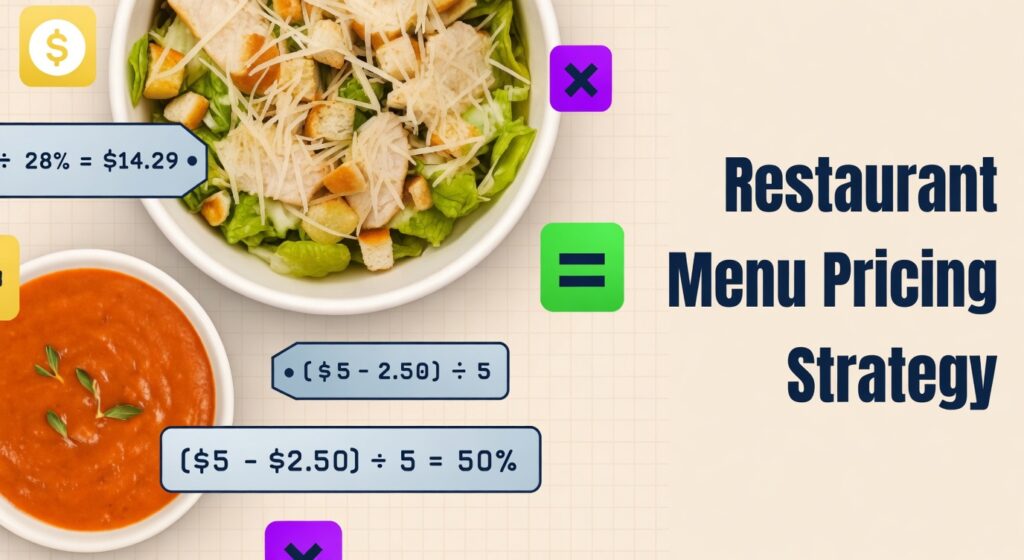
For example if a dish costs 4 dollars to make in ingredients and you want food costs to be 30 percent of the selling price then the formula is 4 divided by 0.30 which equals about 13.33 dollars. You would then round it to a nice number like 13.99 or 14 dollars.
Why this formula works
If you set a 30 percent food cost target it means the ingredients make up only 30 percent of what the customer pays. The other 70 percent helps cover labor rent utilities and your profit.
Common food cost targets
Most restaurants aim for food costs between 25 and 35 percent of the selling price.
25 percent food cost means you are marking up the ingredients by 4 times.
30 percent food cost means marking up about 3.3 times.
35 percent food cost means marking up about 2.86 times.
To keep it at least double
Double your ingredient cost is the minimum for basic coverage but it leaves very little room after other expenses. For example if ingredients cost 5 dollars doubling would set the price at 10 dollars. This gives you only 50 percent food cost which is usually too high for a healthy restaurant. Most successful places target at least triple the ingredient cost or more to reach that 25 to 35 percent food cost range.
Gross profit margin explained
Gross profit margin is the percentage of the selling price that remains after subtracting the raw ingredient cost.
The formula for gross profit margin is menu price minus ingredient cost divided by menu price then times 100 to get the percentage.
Using the earlier example a 13.33 dollar price with 4 dollar cost gives a gross profit of 9.33 dollars. Then 9.33 divided by 13.33 equals about 70 percent gross profit margin.
Aim for at least 65 to 75 percent gross profit margin on most menu items after ingredient costs. This helps cover all other business expenses and leaves room for net profit.
Overall restaurant profit margins
After paying for labor rent and other overhead the final net profit for many restaurants ends up between 3 and 6 percent of total sales. That is why keeping food costs controlled with the right pricing formula is so important.
Quick steps to use this at home or in your restaurant
1. Write out the exact recipe and measure every ingredient for one serving.
2. Add up the current cost of all those ingredients.
3. Decide your target food cost percentage usually 28 to 33 percent.
4. Divide the ingredient cost by that percentage as a decimal.
5. Round the result to a customer friendly price like ending in 99 cents or a whole number.
6. Check the actual food cost percentage once the dish is priced to make sure it stays in range.
Example
Ingredient cost 3.50 dollars
Target food cost 30 percent or 0.30
Price 3.50 divided by 0.30 equals 11.67 round to 11.99 or 12 dollars
Food cost percentage 3.50 divided by 12 equals about 29 percent
Gross profit margin about 71 percent
Review your prices every few months as ingredient costs change. This formula helps you stay profitable while offering fair prices that keep customers coming back.


3 thoughts on “Understanding Price Points and Menu Design for Your Restaurant”