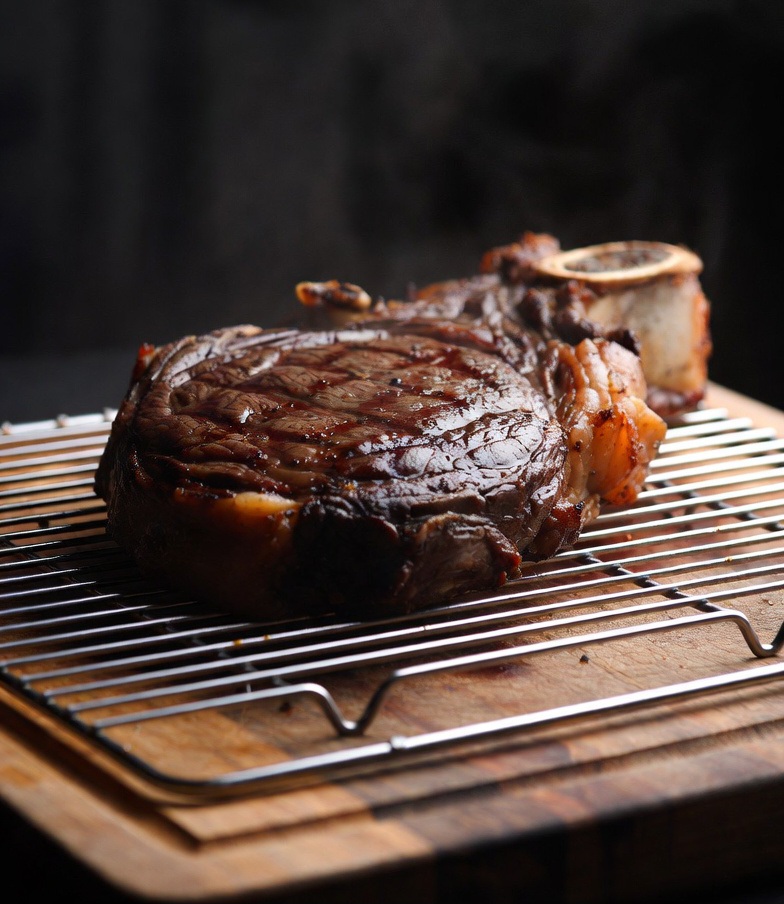
You just got rocked by a 40-ticket firing order. Your station is pushing the red line, the grease trap is humming, and the expo is screaming for that bone-in ribeye. You sear it to perfection, check it with a quick finger poke—boom, perfect medium-rare—and slide it onto the pass.
Five minutes later, it bounces back from table 4. Cut open, gray, and overcooked.
What happened? You didn’t get out-cooked; you got sabotaged by physics. You forgot about carryover cooking.
In high-volume kitchen survival, understanding carryover cooking isn’t some fancy culinary school theory—it’s the difference between executing a flawless service and drowning in recooks while the chef tears you a new one. Here is the raw philosophy, the breakdown, and the exact science of when to pull that protein off the heat.
THE PHILOSOPHY: THE HEAT DOESN’T STOP WHEN THE FLAME DOES
When you yank a piece of meat off a 900-degree grill or a screaming hot cast-iron skillet, the cooking process doesn’t magically pause.
Think of a steak like a sponge that’s been sitting in water. The outside layer is saturated with intense, aggressive heat. The inside core is cooler. When you remove the steak from the heat source, that intense energy trapped in the outer layers doesn’t just evaporate into the air; it continues to march inward toward the center, seeking equilibrium.
THE LINE COOK’S MANTRA: You do not cook meat TO the final temperature on the line. You cook it to the PULL temperature, and you let physics finish the job on the board.
If you don’t account for this, you are practically giving yourself a “participation trophy” for trying hard but delivering a ruined piece of meat. To survive the line, you have to read the future.
THE BREAKDOWN: THE MATH OF THE REST
How much will the temperature actually rise? It depends entirely on the mass of the protein, the intensity of your cooking surface, and whether there is a bone involved.
Here is your general line-guide for how much a temperature will jump during a 10-minute rest:
Cut Size / Type | Temperature Jump | The Survival Strategy
Thin Cuts (Flank, Skirt, thin pork chops): 2 to 5 degrees F rise. Little mass to hold heat. Pull it right before it hits target.
Standard Steaks (1.5″ New York Strip, Ribeye): 5 to 8 degrees F rise. The classic danger zone. Pull it a full half-shade under.
Thick / Bone-In Cuts (Double-cut chops, Tomahawks): 8 to 12 degrees F rise. Massive heat retention. The bone acts as a thermal radiator.
Large Roasts (Prime Rib, Whole Pork Loins): 15+ degrees F rise. A literal thermal battery. Pull it incredibly early.
THE CHEAT SHEET: WHEN TO PULL IT OFF
If a customer wants a true Medium-Rare (130 to 135 degrees F), and you pull it off the grill when your thermometer reads 135 degrees F, congratulations—by the time the runner drops it on the table, it’s a Medium-Well tragedy.
To survive the rush, use this target pull-guide for standard 1.5-inch steaks:
Rare: Target is 120 degrees F -> Pull at 115 degrees F
Medium-Rare: Target is 130 degrees F -> Pull at 123 to 125 degrees F
Medium: Target is 140 degrees F -> Pull at 132 to 135 degrees F
Medium-Well: Target is 150 degrees F -> Pull at 142 to 144 degrees F
Well-Done: Pull it whenever it feels like a boot heel; carryover can’t hurt it anymore anyway.
THE CRUCIAL STEP: THE REST IS NOT OPTIONAL
Pulling it off early only works if you let it rest.
When meat cooks, the muscle fibers constrict, squeezing the moisture out toward the surface. If you cut into a steak the second it leaves the grill, all those juices bleed out onto the cutting board, leaving the meat dry and gray.
During the rest, two beautiful things happen:
1. The carryover heat gently finishes cooking the center to a perfect, uniform color.
2. The muscle fibers relax, allowing those delicious juices to redistribute back throughout the entire steak.
Pro-Tip for Line Survival: Never rest a steak on a cold stainless-steel prep table—it siphons the heat right out of the bottom. Rest it on a warm wooden board or a wire rack set over a sizzle platter near the pass.
Master the carryover, dominate your station, and stop letting physics beat you at your own game.
Survival Strategies When Your Answer Isn’t a Bottle or a Fight
Beyond Stretching: Real Ergonomics for Line Cooks