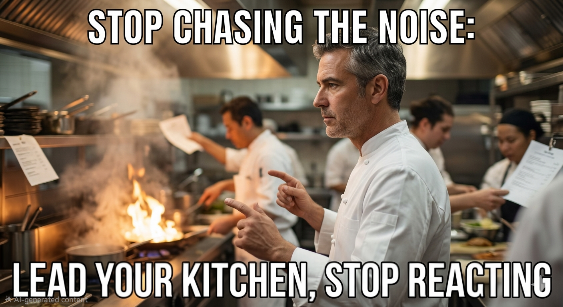
Stop Chasing the Noise: Lead Your Kitchen, Stop Reacting
I am a firm believer that if you want to outperform the average restaurant employee in any position, you must master the minor details of the entire restaurant ecosystem and its underlying economics. Knowledge is power, having power gives you leverage, leverage gives you advantage. That’s survival!
If you re-engineer your entire line every time a single customer complains or a loud voice barks, you aren’t running a kitchen you’re firefighting. One bad review shouldn’t alter a menu. One rough ticket shouldn’t dictate a new rule. When you react to every piece of daily chatter, you give your crew whiplash and completely bury your standards.
Bad services happen. The real danger comes when you mistake a one-off anomaly for a broken system. Constantly tweaking your rules under pressure isn’t “fixing things” it’s operational drift.
Strong operators don’t chase noise. They protect the standard and only pivot when the data demands it.
The Operational Filter
Before you shift a line layout, alter a spec sheet, or change a protocol, filter the noise through these core checkpoints:
Pattern vs. Outlier: Is this a recurring breakdown, or just a single rough night on the line?
Hard Evidence Only: Look at the objective numbers ticket times, waste logs, comps, and send-backs not raw emotion or a single loud voice.
The Root Cause: Is the failure a people problem, a process flaw, a product defect, or a pace issue? Fix the source, not the symptom.
The Training Cost: Every single time you alter a system, you burn training hours and sacrifice consistency. Make sure the change is actually worth the tax on your crew.
Feedback is just data to be filtered, not a command to be followed. Stop letting a rough hour dictate your long-term strategy. Lock in your standards, protect your line, and let data prove when it’s actually time to evolve.
The weekend kitchen audit: a practical guide to restaurant economics